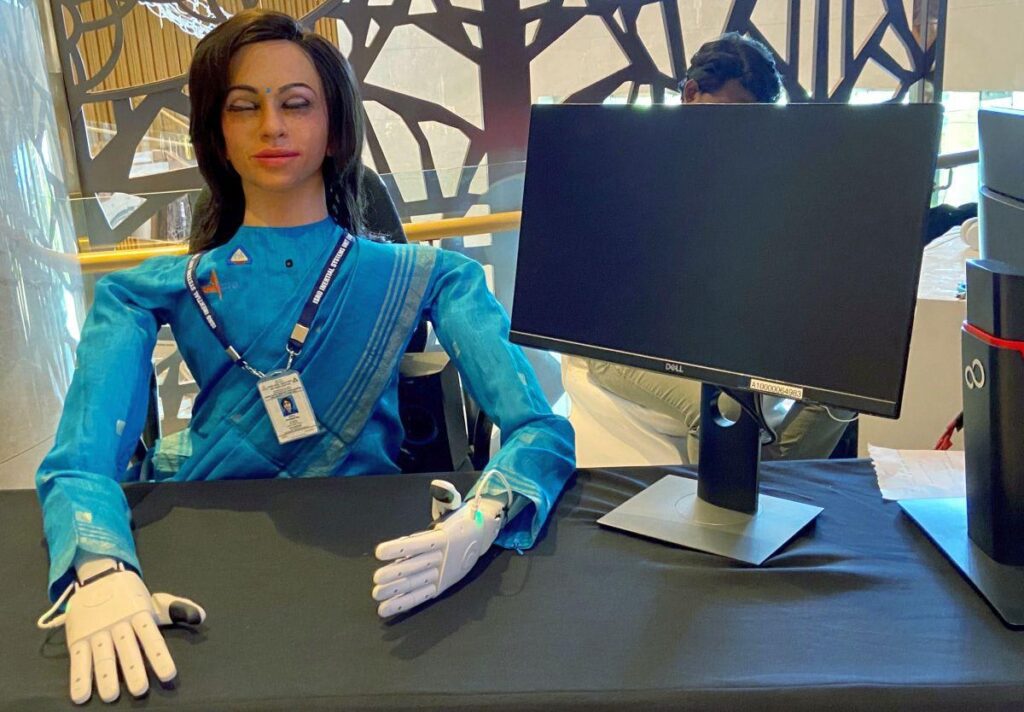
India’s space agency is preparing to launch its most sophisticated robotic astronaut in December, marking a crucial milestone toward the country’s first human spaceflight mission. The Indian Space Research Organisation announced Thursday that Vyommitra, an AI-enabled half-humanoid robot, will fly aboard the inaugural uncrewed test of the Gaganyaan program, bringing India closer to joining the exclusive club of nations capable of independent human space exploration.
ISRO Chairman V. Narayanan confirmed the timeline while speaking to reporters at Coimbatore Airport, revealing that 85% of the research work for the Gaganyaan program has been completed. The robot, whose name combines the Sanskrit words “vyoma” (space) and “mitra” (friend), will simulate human functions during the three-day orbital mission at an altitude of 400 kilometers.
Testing Critical Systems Before Human Flight
Vyommitra represents a technological leap designed to validate spacecraft safety before astronauts take their turn. The half-humanoid robot, built primarily from aluminum alloy to withstand extreme conditions, can monitor cabin parameters including temperature, pressure, humidity, and carbon dioxide levels. According to ISRO officials, the robot features artificial intelligence capabilities that enable it to recognize human voices, operate switch panels, and provide real-time system updates.
“Work is going on. We have planned to send the unmanned spacecraft this December-end,” Narayanan told reporters, emphasizing the comprehensive safety measures being implemented. The mission includes an escape system and nine parachutes designed to ensure safe splashdown in the sea should emergencies arise.
The December test flight, designated G1, will be followed by two additional uncrewed missions in 2026 before ISRO attempts its first crewed spaceflight in the first quarter of 2027. This systematic approach reflects lessons learned from international space programs, including recent challenges with commercial missions that ISRO helped resolve through technical expertise.
Broader Space Ambitions Take Shape
The robot launch represents just one component of India’s expanding space program. ISRO has selected four astronauts for eventual human missions, with Prime Minister Narendra Modi requesting the selection of additional candidates. The agency has also outlined ambitious long-term goals, including establishing its own space station by 2035 and conducting a crewed lunar landing by 2040.
These developments build on India’s recent space achievements, including the successful Chandrayaan-3 lunar landing and ongoing solar research through the Aditya L1 mission. The Gaganyaan program involves collaboration across multiple Indian institutions, including the Air Force, Navy, and Defence Research and Development Organisation.
With over 7,700 of the program’s 9,000 required tests already completed, ISRO expects to finish remaining validations by March 2026. The December launch of Vyommitra will provide crucial data on spacecraft performance in microgravity, helping engineers refine safety protocols before entrusting human lives to the system.