
In the global race for AI dominance, national budgets have become the primary scoreboard, but a deeper look at India’s 2026 plan reveals a strategy that can’t be measured in money alone. India’s plan is not just about spending; it’s a structural blueprint for building a self-reliant AI nation from the ground up. This article breaks down the four most impactful and unexpected elements of India’s plan, revealing a strategy focused on infrastructure, talent, and practical application over headline-grabbing figures.
1. The Goal Isn’t Just AI—It’s “Sovereign Compute”
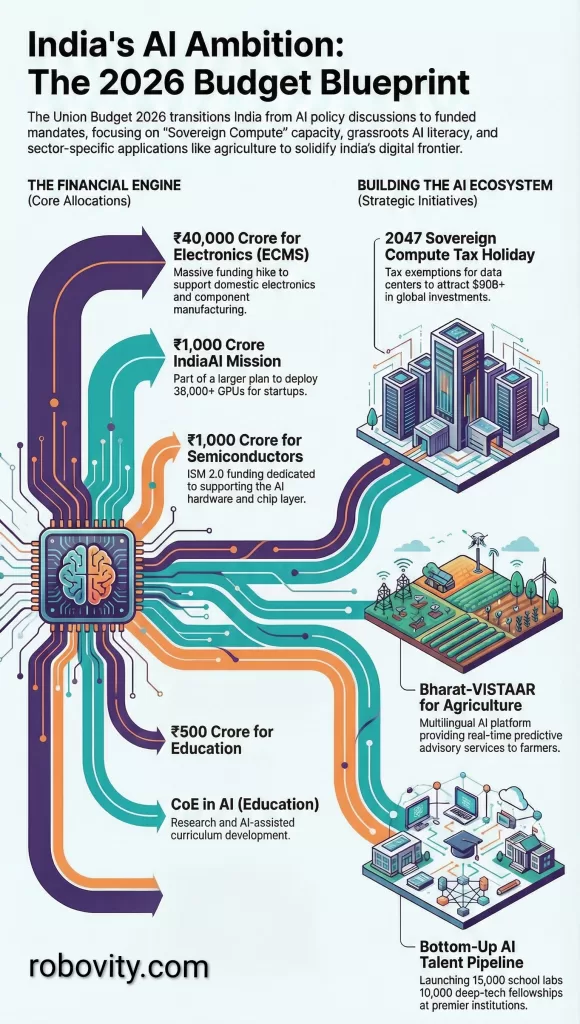
The cornerstone of India’s strategy is the concept of “Sovereign Compute”—a national priority to ensure that Indian data is stored and AI models are processed within the country’s own borders. To achieve this, the budget introduced a radical long-term policy: the “2047 Tax Holiday” for data centres. This initiative is designed to attract $90+ billion in global investments for building out AI-ready data infrastructure locally.
This reveals a coherent “full-stack” hardware strategy. Instead of remaining a consumer of foreign cloud services, India is creating a vertically integrated supply chain for technological sovereignty. This strategy is reinforced by funding for the domestic semiconductor industry (ISM 2.0) and a massive ₹40,000 Crore allocation to boost electronics manufacturing (ECMS). The message is clear: India is building everything from the silicon level, to component assembly, to the final compute infrastructure that will power its digital future.
2. The AI Revolution is Being Built From the Ground Up
While many nations focus on elite universities and post-graduate research, India’s budget reveals a deliberate “bottom-up” approach to building a natively skilled workforce. The plan calls for establishing 15,000 AI Labs in secondary schools across the country, embedding AI literacy into the earliest stages of education. Reinforcing this vision, the budget also allocates ₹500 Crore to create a Centre of Excellence in AI for Education, tasked with pioneering AI-assisted teaching and curriculum development.
This grassroots effort is complemented by a top-tier initiative: 10,000 new Tech Fellowships at premier institutions to drive deep-tech and AI research. By covering the entire educational spectrum, India is making a long-term investment in its human capital. The goal is not just to hire AI talent, but to create a massive, homegrown pipeline of engineers, researchers, and developers to solve the talent gap for decades to come.
3. AI is Being Deployed in Unexpected Sectors
India’s AI strategy is defined by its practical, sector-specific applications that extend far beyond the tech industry. The budget introduces “Bharat-VISTAAR,” a multilingual AI platform designed to give farmers real-time, localized advice to minimize crop risks. This initiative aims to deploy advanced predictive AI to support one of the country’s most traditional and vital sectors.
This focus on practical application extends from the nation’s oldest industries to its newest, as the government simultaneously invests in AI’s role in the burgeoning creative sector. The plan includes setting up AVGC (Animation, Visual Effects, Gaming, and Comics) Content Labs in 15,000 schools and 500 colleges to bolster the “Orange Economy.” This highlights a strategy that sees AI not just as an abstract technology for data scientists, but as a practical tool for empowering everyone from farmers in rural villages to digital artists in urban centers.
4. The Billion-Rupee Figure is Just the Tip of the Iceberg
The headline figure from the budget is the ₹1,000 Crore allocated to the IndiaAI Mission for the fiscal year. While significant, this number is misleadingly small. It is merely the first installment of a much larger, five-year approved plan totaling ₹10,372 crore. The ultimate goal of this larger fund is to deploy over 38,000 GPUs, making immense compute power accessible and affordable for Indian startups and researchers.
Furthermore, when viewed alongside related allocations, the true scale of the ambition becomes clear. The ₹40,000 Crore earmarked for electronics manufacturing alone reveals that the true financial commitment to the enabling ecosystem is 40 times larger than the AI Mission’s annual headline budget, a clear signal of the government’s priorities. The funds are strategically spread across hardware, infrastructure, and application layers.
Conclusion: A Blueprint for the Future
India’s 2026 AI budget is far more than a spending plan; it’s a structural blueprint for building a self-reliant, deeply integrated, and widely accessible AI ecosystem. By prioritizing sovereign compute, grassroots education, and practical, sector-specific applications, the strategy aims for sustainable, long-term leadership.
The proposed formation of a High-Powered ‘Education to Employment and Enterprise’ Standing Committee further signals the government’s focus on proactively managing the societal transition to an AI-driven economy. India is methodically laying the tracks for an AI-powered future, but the critical question remains: will this ambitious execution be able to keep pace with the speed of global innovation?